
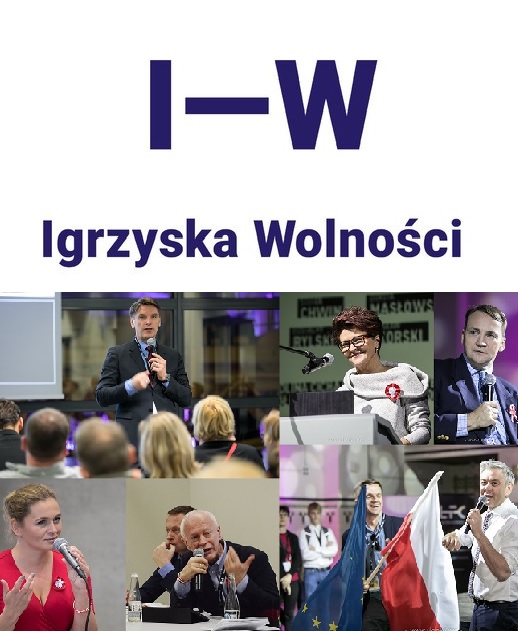
September 13–15, 2019 || Łódź, Atlas Arena
We already know the date and place of the 6th edition of IW! One thing is certain: we are in for 3 days filled to the brim with panels, meetings and concerts. And all this with the participation of great figures from the world of politics, culture, science and business.
TICKET SALES: https://sklep.liberte.pl/product/karnety-na-iw-2019/
Freedom Games 2019: we present the first speakers | Pass sale has started!
"How do democracies win?"
13-15.09.2019, Lodz, Atlas Arena
ONLINE TICKET SALES HAVE STARTED!
This year's edition of the event entitled. "How do democracies win?" will be held on September 13-15, 2019.
The main part of the program will take place at Atlas Arena in Lodz. A part of the cultural program will also take place in the club cafe 6th District, on 102 Piotrkowska Street in Lodz.
We present the first speakers of the 2019 Freedom Games!
Olga Tokarczuk - writer, essayist, screenwriter, poet, psychologist. Winner of The Man Booker International Prize 2018 for the novel Bieguni (Flights) and two-time winner of the "Nike" Literary Award for her novels: Bieguni (2008) and Ksiegi Jakubowe (2015).
She graduated from psychology at the University of Warsaw. She is the recipient of many awards, including the Koscielski Foundation Award (1997) and "Polityka" Passport (1997), the Slaska Cultural Award (2003), the Samuel Bogumil Linde Award of the twin cities of Toruń and Göttingen (2008) and the Usedom Literary Award (2012). She has been nominated four times for the Nike Literary Award, which she received in 2008 for the novel Bieguni. For The Day House, The Night House she received the prestigious "Brücke Berlin"-Preis award (2002) and was nominated for the International IMPAC Dublin Literary Award (2004).
Masha Gessen: one of the greatest critics of Vladimir Putin's rule in Russia, author of the books: "Putin. Czlowiek bez twarzy", "Bedzie to co bylo - how totalitarianism is reborn in Russia" and "Slowa skrusza mury. Pussy Riot." An activist for the human rights of LGBT people. She is a columnist for such magazines as The New York Times, The Washington Post and The New Republic. By day, she lives in New York and is a visiting professor at Amherst College. She has won numerous awards, including a Guggenheim Fellowship and a Carnegie Fellowship.
Justyna Kopinska: reporter, sociologist. She deals with criminal topics, related to criminal law, courts and prisons. She was the first journalist from Poland to receive the "European Pulitzer", or European Press Prize in the category of "Distinguished Writing Award".
Winner of the Amnesty International Journalism Prize - Pen of Hope. She won PAP's Ryszard Kapuscinski Award, Grand Press, Newsweek's Teresa Toranska Award and Radio ZET's Andrzej Woyciechowski Award. She is the author of the books "Czy Bóg wybaczy Sister Bernadetta?", "Polska odwraca oczy", "Z nienawisci do kobiet". After the publication of her reports, criminals were sent to prisons, and changes were made in the law regarding safety in institutions closed to children.
Tom Palmer: deputy director of international programs at Atlas Network, where he is responsible for developing operational and program management programs for the international network of think tanks. Senior advisor at the Cato Institute and director of Cato University. Before joining Cato he was a member of H. B. Earhart at Hertford College at Oxford University and vice president of the Institute for Humanistic Studies at George Mason University. He regularly lectures in North America, Europe, Eurasia, Africa, Latin America, India, China and other Asian countries and the Middle East on political science, public choice theory, civil society and the moral, legal and historical foundations of individual rights. He has published reviews and articles on politics and morality in such scholarly journals as the Harvard Journal of Law and Public Policy, Ethics, Critical Review, and Constitution Political Economy, as well as in magazines such as Slate, Wall Street Journal, New York Times, Die Welt, Caixing, Al Hayat, Washington Post and London's The Spectator. He is the author of: "Realizing Freedom: Libertarian Theory, History, and Practice" (expanded edition, 2014) and editor of "Morality of Capitalism" (2011), "After the Welfare State" (2012), "Why Liberty" (2013), "Peace, Love & Liberty" (2014) and "Self-Control or State Control? You Decide" (2016).
Adam Bodnar: lawyer, social activist, Ombudsman. From 2004-15 associated with the Helsinki Foundation for Human Rights. Expert of the European Union Agency for Fundamental Rights. In 2013 -2014 member of the Board of Directors of the UN Fund for Victims of Torture. From 2001-2004 he worked as a lawyer at the law firm Weil, Gotshal & Manges. Since 2006 he has been lecturing at the Faculty of Law and Administration at Warsaw University. Until becoming an Ombudsman, he cooperated with numerous non-governmental organizations, including the Panoptykon Foundation (chairman of the Foundation's Council), ClientEarth Poland (member of the Program Council), Prof. Zbigniew Holda Association (co-founder and member of the Board). He was also a member of the Legislation Forum operating at the Batory Foundation. In 2011 he was awarded the Award of Tolerance by the LGBT Islations.
Joanna Bator: a writer and essayist. By education she is a cultural studies scholar and philosopher. For the sake of literature she gave up academic work and journalism. Earlier she worked at universities in London, New York and Tokyo. She is the author of novels (Piaskowa Góra 2009, Chmurdalia 2011, Ciemno, prawie noc 2013, Rok Królika 2016, Purezento 2017), as well as essays and reportages: Japonski wachlarz (2004), Japonski wachlarz. Returns ( 2011), Shark from Yoyogi Park (2014), Island of lza (2015), Tastes and Signs (2016).She has won many awards and honors, among them the Beata Pawlak Award, the Polish Book Publishers Award, the Nike Literary Award, the Swiss Spycher Literaturepreis, Silesianke. In 2014 she was honored with an invitation to a guest professorship in world literature named after F. Dürrenmatt at the University of Bern, and in 2015-16 she stayed in Berlin as Artist-in-Residence of the German DAAD Foundation. Her bestselling novel Ciemno, prawie noc (Darkness, Almost Night) lived to see a film adaptation directed by Borys Lankosz, in which the author made her acting debut.
Prof. Marek Safjan: lawyer, judge, specialist in civil law, professor of legal sciences, from 1998 to 2006 president of the Constitutional Court, since 2009 has served as a judge of the Court of Justice of the European Union. Since 2000 Grand Officer of the Order of Merit of the Italian Republic. In 2010 he was awarded the Commander's Cross of the Order of Polonia Restituta.In 2004 he received the Priest Idzi Radziszewski Award of the Scientific Society of the Catholic University of Lublin. In 2006 he was awarded the Kisiel Prize, and in 2007 he was honored in Strasbourg with the Medal Pro merito for his activities as president of the Constitutional Tribunal and his involvement in the work and activities of European research and academic institutions.
Agnieszka Dziemianowicz - Bak: social activist, politician and education researcher. Co-employee of the Ferdinand Lassalle Center for Social Thought in Wroclaw, member of the international movement for the democratization of Europe DiEM25. One of the organizers of the Black Protest against the anti-abortion law in 2016, for her involvement placed - along with Barbara Nowacka - by the American magazine Foreign Policy on the list of the 100 most important intellectuals in the world. For more than 3 years, until February 2019, she was a member of the National Board of the Together Party. Currently, she is non-partisan. In 2018 she defended her doctoral thesis at the Institute of Philosophy at the University of Wroclaw entitled Reproduction - Resistance - Empowerment. A radical critique of education in contemporary Western social thought.
Marcin Meller: historian, graduate of the Historical Institute at Warsaw University. In the years 1991-2003, reporter for Polityka weekly, often working as a war correspondent. In the years 2003-2012 editor-in-chief of the Polish edition of "Playboy". Since 2000 associated with the TVN station. Currently hosts "Drugie Sniadanie Mistrzów" on TVN24 and "Dzień Dobry TVN" together with Magda Molek. In 2011-12 a columnist for the weekly "Wprost" and from 2012 to the present the weekly "Newsweek". Author of several books including: "Gaumardzos. Stories from Georgia.", "Bat and dried lemons".
Ivan Krastev: Chairman of the Center for Liberal Strategies in Sofia and permanent associate of the Institute of Humanities in Vienna. Founder and member of the board of directors of the International Council on Foreign Relations and member of the supervisory board at the International Council on Foreign Relations. He has written numerous articles for the New York Times. In 2018-2019, he served as the Henry A. Kissinger Chair in Foreign Policy and International Relations at the John W. Kluge Center at the US Library of Congress. He recently published in English "After Europe" (UPenn Press, May 2017), "Democracy Disrupted. The Global Politics on Protest" (UPenn Press, May 2014), "In Mistrust We Trust: Can Democracy Survive When We Do Not Trust Our Leaders?" (TED Books, 2013).
Sofia Nerbrand is a Swedish opinion leader and journalist. She began her career as a head writer at Dagens Nyheter, VLT and VK in 1998. From 2002 to 2005 she was editor and editorial secretary of Axess magazine. She then founded the liberal social magazine Neo, where she served as editor-in-chief and general manager. She was also an independent columnist for "Svenska Dagbladet" for seven years, and for a time a columnist for "Allehanda Ystad." She is currently chairwoman of the liberal think tank Bertil Ohlin Institute and a member of the liberal and green think tank Fores Board.
Wojciech Sadurski: is professor of philosophy of law at the University of Sydney and professor at the European Center at Warsaw University. His academic interests include legal theory and philosophy, comparative constitutional law and political philosophy. His recent books include Poland's Constitutional Breakdown (OUP 2019), Constitutionalism and the Enlargement of Europe (OUP 2012), Equality and Legitimacy (OUP 2008), and Rights before Courts (Springer 2005 and 2014). He has taught at the law faculties of Yale University, New York University and Fordham University, among others. He is a member of the program advisory boards of numerous think tanks, including the Institute of Public Affairs and the Helsinki Foundation for Human Rights.
Slawomir Sierakowski: sociologist, publicist, co-founder of Krytyka Polityczna. President of the Stanislaw Brzozowski Association. Graduated from MISH at the University of Warsaw. Worked under Ulrich Beck at the University of Munich. He was a grantee of the German Marshall Fund, the Viennese Institute for Human Sciences, Yale, Princeton and Harvard Universities. He is currently the Richard von Waizsäcker Fellow at the Robet Bosch Academy in Berlin. He is a member of the "Polityka" team, a regular columnist for "Project Syndicate" and an author in the New York Times, Foreign Policy and Die Zeit.
Jaroslaw Gugala: journalist associated with, among others, Telewizja Polska and Polsat, musician and diplomat. From 1999-2003 ambassador of the Republic of Poland to Uruguay. In 1990 he began working at the newly established Wiadomosci on TVP1, initially as a reporter, later also as an editor and presenter. In 1999 he was appointed Ambassador Extraordinary and Plenipotentiary to Uruguay. After leaving the diplomatic service he joined the Polsat commercial television station as a presenter and publisher of the Information program. From 2005 to 2007 he was also the host of the Tuesday editions of Radio TOK FM's Morning. From 2006 on TV 4 he hosted an original publicist program IV wladza. He wrote columns for the weekly "Newsweek Polska". Since 2008 he has also worked for Polsat News as a host of, among others, the magazines Gosc Wydarzen and Wydarzenia Opinions Comments. In 2014 he was awarded the Officer's Cross of the Order of Polonia Restituta.
Pawel Potoroczyn: cultural manager, journalist, publicist, entrepreneur and diplomat. From 2008 to 2016 director of the Adam Mickiewicz Institute. In 2017 he became director general of SWPS University of Humanities and Social Sciences, holding this position until 2018. He has published in Polish and foreign journals. In 2014 he was nominated for the Nike Literary Award and the Gdynia Literary Award for his debut novel "Czlowiekka rzecz" (W.A. Publishers, Warsaw 2013).
Full speaker descriptions available at: https://igrzyskawolnosci.pl/prelegenci/
Organizer: Liberté Foundation!
Strategic Partner: City of Lodz
Partners:
Open Society Foundations, European Liberal Forum
Supporting partners:
Friedrich-Naumann-Stiftung Für die Freiheit, Orange
Content partners:
4Liberty.eu, FOR - Civil Development Forum, Bronislaw Geremek Center Foundation, nienieodpowiedzialni.pl, KOD - Lodzkie, Republikon Foundation, Lithuanian Free Market Institute, INESS, Lodz Democracy Ark
Dialogue partners:
Media patronage: Toya TV, Gazeta Wyborcza
About the Freedom Games
Freedom Games is a meeting of people curious about the world and hungry for new ideas. It is an interdisciplinary cultural and intellectual forum, whose primary goal is to create a creative meeting space for people of culture, business and public life from various sectors.
It is a discussion of the most important challenges facing Western societies in the 21st century. It is a grassroots forum created by non-governmental organizations, bringing together people who share values such as liberal democracy, open society and the rule of law.
The theme of the sixth edition of the event will be the key question today, "How do democracies win?" In the last thirty years, communism has collapsed, the Soviet Union has disappeared. The world's largest superpower, the US, is slowly, though inexorably, losing the position of world hegemon it received after winning the Cold War. There have been radical transformations in communications, technology, labor organization, and even trade and warfare. The progressive emancipation of groups discriminated against for centuries, secularization and migration have significantly changed homogeneous (often seemingly) societies. The economy became global, while politics remained local (national). Not surprisingly, democracy in the liberal edition is undergoing significant strains today.
Democracy is, contrary to appearances, not only and not primarily, elections. It's a social fabric, institutions, political culture, a set of rules and behaviors, and finally, the civic sensibility of each of us. It's both the festivity of elections and the everydayness of the Internet and television. A democracy that is devoid of regulations is no longer a democracy, just as a soccer match in which the referee does not whistle fouls is not a match, but a brawl accompanied by a ball.
The year 1989 marked the great triumph of democracy, the culmination of what Samuel Huntington called the Third Wave of Democratization. Therefore, at the Freedom Games in Lodz, we will talk about how democracies win. However, 2019, in a different way than 30 years ago, will also be a time of strategic choices for Poland.
At the same time, the Games will remain, as every year, an intellectual, educational and cultural event, duringwhich it will be possible to meet the most interesting creators of Polish culture and prominent representatives of world academia.
We combine an ambitious program with the greatest possible openness to citizens.
Over the five years since the first organized edition of the event, the Organizer has proven that it is able to engage the most prominent intellectuals, people of culture and public life of the world to participate in the forum.
If you have questions, write: pchuszcz@liberte.pl
directions
You will arrive in many ways. You can comfortably get there by public transport, train or car. For our guests we have prepared comfortable parking lots and bicycle racks.
Learn more